
Why Tree Roots Love Your Garden Oaks Clay Pipes (And The Best Ways to Stop Them)
Garden Oaks remains a premier residential destination in Houston because of its massive canopy of mature trees. While those Live Oaks and Pecan trees provide shade and curb appeal, they are the main enemy of your underground plumbing. If you live in this area, your home likely sits on a network of clay sewer pipes that were installed many years ago. These pipes are a magnet for thirsty root systems seeking moisture during the hot Houston summers. Understanding why this happens and how to address it in 2026 can save you from a major sewage backup in your home.
The soil in this part of Houston consists of expansive clay often called Houston Gumbo. This soil moves constantly as it absorbs and loses water. When we have a dry spell, the clay shrinks and pulls away from your pipes. When the rain returns, the soil expands and puts immense pressure on the rigid clay sewer lines. This constant movement causes the joints between pipe sections to shift or crack. These tiny openings are all a tree root needs to enter your sewer system. Once a single root hair finds its way into a pipe, it has access to a constant supply of water and nutrients. It will grow rapidly, eventually filling the entire diameter of the pipe and causing a total blockage.
Clay pipes were the standard for residential construction for a long time. They are strong under compression but very brittle. The joints in these systems were often sealed with materials that degrade over time. Trees like the Live Oak have aggressive root systems that can sense the moisture vapor escaping from a loose pipe joint. If your drains are running slow or you hear a gurgling sound when you flush the toilet, you are dealing with root intrusion. If you find yourself in a situation where your system has failed completely, you need a professional who can get to you fast to handle an emergency spill.
The Biology of Tree Root Intrusion in Houston Sewer Systems
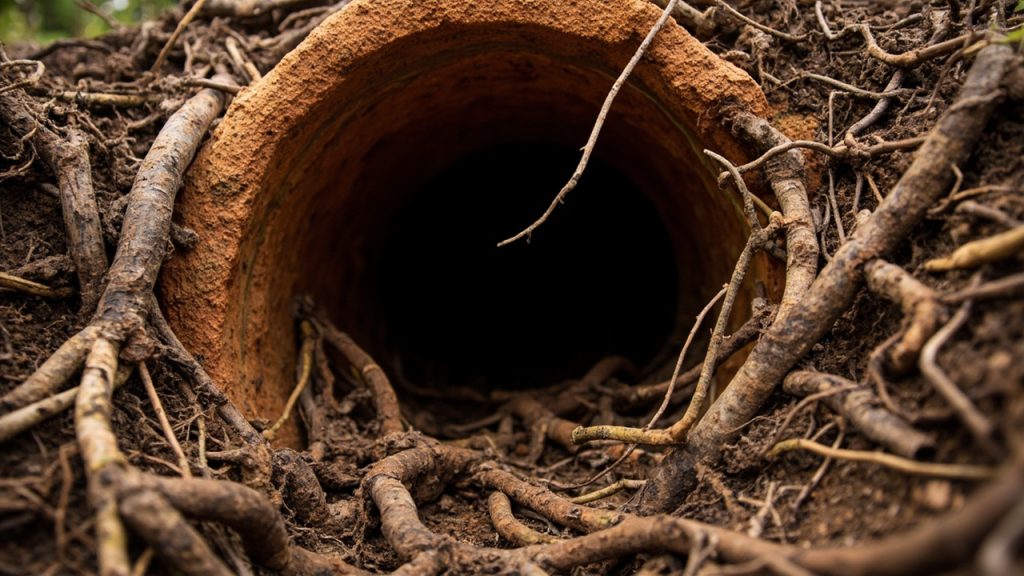
Roots do not break the pipes initially. They wait for the Houston Gumbo clay to do the heavy lifting. Once a crack forms due to soil shifting, the roots follow the trail of moisture. Inside a sewer pipe, the environment is warm and full of nitrogen and phosphorus. This is liquid fertilizer for a tree. A root that enters as a thin strand can grow as thick as a human arm within a few seasons. As the root grows, it exerts outward pressure on the clay pipe wall. This pressure will eventually shatter the pipe from the inside out.
We see this most often in older neighborhoods like Garden Oaks because the trees have had many decades to establish deep and wide root zones. The root system of a mature tree often extends two to three times the width of its leaf canopy. This means a tree in your neighbor yard could be the cause of the backup under your driveway. Many homeowners try to solve this by renting a snake from a hardware store, but this is only a temporary fix. A mechanical snake just pokes a small hole through the root mass. It does not remove the roots or fix the entry point. For a permanent solution, you should look into professional sewer repair services that address the source of the problem.
Houston Municipal Codes for Sewer Line Replacement in 2026
Working on sewer lines in Garden Oaks requires strict adherence to the City of Houston Code of Ordinances. Under Chapter 31 and Chapter 40, any repair or replacement of a sanitary sewer lateral must be performed by a licensed plumber. The city requires a plumbing permit before any excavation or lining begins. This ensures that the work meets the current 2026 standards for health and safety. One specific requirement for Houston residents is the installation of a two way cleanout. This allows plumbers to access the line in both directions toward the house and toward the city main.
Another critical municipal requirement involves the use of backwater valves. In areas prone to heavy rain and flash flooding, the city code mandates these valves to prevent city sewage from backing up into your home. The transition from your private line to the city sewer main also has specific rules. In Garden Oaks, we must use specific shielded couplings to join different pipe materials. These couplings prevent the shifting soil from creating new offsets at the connection point. Failure to pass a city inspection can lead to costly redos and delays in your project timeline.
Comparing Modern Root Removal Methods
In 2026, technology has moved beyond just cutting roots with a steel cable. We use high resolution cameras and high pressure water to clear lines completely. The following table shows the differences between the common methods used to handle root issues in Houston.
| Removal Method | Effectiveness Level | Impact on Pipe Life | Typical Duration of Results |
|---|---|---|---|
| Traditional Snaking | Low | Can damage brittle clay | 3 to 6 months |
| Hydro Jetting | High | Cleans pipe walls | 1 to 3 years |
| Mechanical Descaling | Very High | Smooths interior surface | 2 to 4 years |
| Chemical Foaming | Medium | Kills new growth | 6 to 12 months |
Hydro jetting uses specialized nozzles that blast water at pressures up to 4000 psi. This pressure is enough to cut through thick root masses and scrub the grease and debris off the pipe walls. It is a much better option than snaking because it restores the full flow capacity of the pipe. However, if the clay pipe has already collapsed or the cracks are too large, we must look at structural repairs. If you are experiencing these issues, you should act quickly to understand the immediate steps for containment.
Technical Deep Dive into the Cured In Place Pipe Process
Cured In Place Pipe or CIPP is the gold standard for trenchless sewer repair in 2026. The process begins with a thorough cleaning of the existing clay pipe. We use hydro jetting and mechanical descaling to remove all roots, grease, and scale. Once the pipe is clean, we take precise measurements of the length and diameter. We then prepare a flexible felt liner made of polyester or fiberglass. This liner is saturated with a two part epoxy resin in a process called wet out. The resin is the magic ingredient that will eventually form the new pipe wall.
After the liner is ready, we use an inversion drum to launch it into the sewer line. Air pressure pushes the liner inside out through the pipe, ensuring the resin side makes direct contact with the old clay walls. Once the liner is fully deployed, we insert a calibration tube. This tube is inflated to press the liner firmly against the host pipe, filling every crack and gap. The curing process then begins. We use hot water or steam to accelerate the chemical reaction of the epoxy. Within a few hours, the resin hardens into a smooth, seamless, and incredibly strong new pipe. Because the new line has no joints, roots have no way to get back in.
The High Resolution Camera Inspection Process
Before we perform any work, we conduct an HD sewer camera inspection. We insert a flexible rod with a high definition camera head into your main cleanout. This allows us to see exactly where the roots are entering and the condition of the pipe. In Garden Oaks, we often see sections of pipe that have dropped or bellied. This creates a pool of standing water that attracts even more roots. The camera footage is essential for proving the location of the problem to insurance companies or for planning a trenchless repair.
Without a camera, a plumber is just guessing. We identify if the pipe is made of clay, cast iron, or PVC. We also see if there are offsets in the joints. An offset occurs when one section of pipe moves higher or lower than the section next to it. This creates a lip that catches toilet paper and solid waste, leading to a clog even before the roots get involved. If your home has hard water issues, that scale can also build up on the edges of root masses, making the blockage even harder to clear.
Tree Species and Their Root Aggressiveness in Houston
Not all trees are equal when it comes to plumbing damage. If you are planning to landscape your Garden Oaks property in 2026, you should be careful about where you plant certain species. Some trees have roots that are specifically adapted to find water at great depths.
- Live Oaks. These are the most common and have persistent roots.
- Willow Trees. These have water seeking roots that can travel over 100 feet.
- Water Oaks. These grow fast and have aggressive root systems that thrive in moist soil.
- Pecan Trees. These have a deep taproot but also wide spreading lateral roots.
- Silver Maples. Known for shallow roots that frequently invade sewer lines.
If you have these trees near your sewer line, you need to be proactive. We recommend a camera inspection every two years to catch root intrusion before it causes a backup. This is especially true if you are considering other major plumbing upgrades. Your new high performance fixtures will not work correctly if the main sewer line is choked with roots.
| Tree Species | Root Type | Risk to Sewer Lines | Safe Distance from Pipes |
|---|---|---|---|
| Live Oak | Lateral and Deep | High | 20 feet |
| Pecan | Taproot and Wide | Medium | 15 feet |
| Willow | Spreading | Very High | 50 feet |
| Crape Myrtle | Compact | Low | 5 feet |
Frequently Asked Questions for Houston Homeowners
Does homeowners insurance cover sewer line replacement? This is a common question in Garden Oaks. Standard HO3 policies usually do not cover sewer line replacement if the damage is due to wear and tear or tree root intrusion. However, if you have a specific service line rider or if the backup caused sudden water damage inside your home, you might have coverage for the cleanup and a portion of the repair. You should review your policy in 2026 to see if you have added these essential endorsements.
How long does a trenchless sewer repair take? One of the biggest advantages of CIPP or pipe bursting is the speed. Most trenchless projects in Garden Oaks are completed in a single day. This includes the cleaning, the lining, and the final inspection. Traditional excavation can take three to five days and requires significant restoration of your lawn or driveway. Trenchless methods minimize downtime and get your water back on by dinner time.
Is CIPP as strong as a new PVC pipe? Yes, the epoxy resin used in 2026 is designed to be a structural repair. It has the strength to stand on its own even if the old clay pipe around it completely disintegrates. It is resistant to chemicals and the smooth interior surface improves flow rates compared to old, rough clay pipes.
Preventive Measures and Annual Maintenance
If your pipes are currently clear, you can keep them that way with regular maintenance. One of the most effective tools is a chemical foaming agent. In 2026, we use AI-enhanced chemical foaming that uses smart sensors to target only the root tissue without harming the rest of the tree. This is an antimicrobial foam that we apply to your sewer line. The foam fills the entire pipe, killing any roots it touches. It also leaves a residue on the top of the pipe that prevents new roots from growing back for up to a year. This is a much better alternative to pouring salt or copper sulfate down your drains, which can be harmful to the tree and the environment.
You should also be mindful of what you flush. Roots create a web that catches everything. If you have roots in your line, items like wet wipes or heavy paper towels will get snagged immediately. This leads to a solid blockage much faster than the roots would on their own. Keeping your sewer line clean is a part of total home health. Just like you would service your HVAC system or check your roof, your underground plumbing needs attention to prevent failures during the rainy season. Modern 2026 maintenance schedules often include biological additives that eat away at the fats and oils that roots use as a foundation for growth.
Expert Plumbing Advice for Garden Oaks Residents
Living in a neighborhood with a high water table and expansive clay soil requires a different approach to home maintenance. The clay pipes in Garden Oaks have served well for many years, but they are reaching the end of their functional lifespan in 2026. Transitioning to modern materials like PVC or using trenchless lining is the only way to permanently stop the cycle of root intrusion and backups. If you notice a patch of grass in your yard that is greener than the rest, or if you smell sewage near your foundation after a rainstorm, do not wait. These are the early warning signs that your sewer line is compromised.
The cost of a camera inspection is minimal compared to the cost of cleaning up a sewage backup in your home. We have seen many beautiful Garden Oaks homes suffer significant damage because a small root problem was ignored until the pipe finally collapsed. By being proactive and using modern diagnostic tools, you can enjoy your mature trees without worrying about what is happening beneath the ground. If you need assistance with a sewer line inspection or want to discuss trenchless repair options, contact a local plumbing professional who understands the unique soil conditions of Houston. If you need immediate help with an emergency spill or want to discuss containment strategies for your property, call us today.